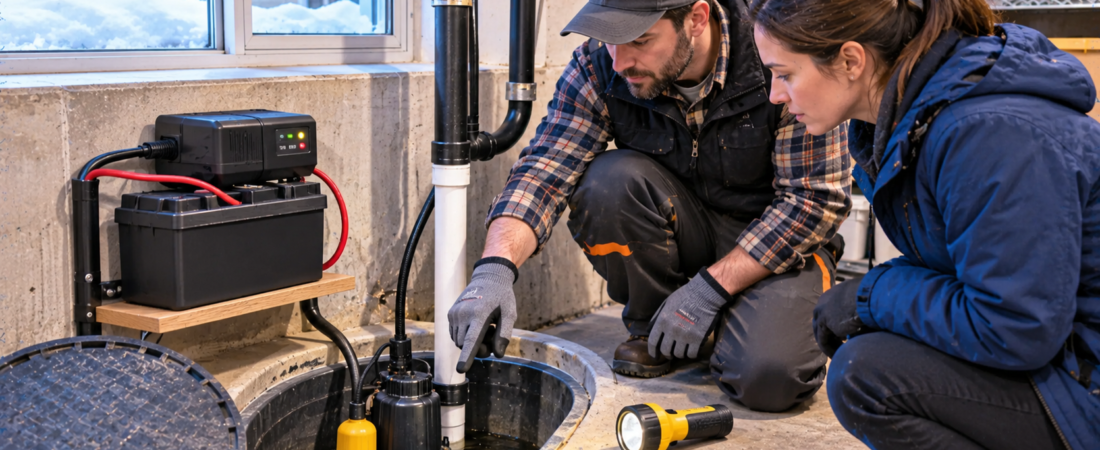
A sump pump can work through ordinary conditions and still leave a basement vulnerable during a thaw. Melting snow and rainfall can increase incoming water, while an electrical outage or blocked discharge route interrupts its removal.
Backup planning needs to address more than keeping electricity available. A powered pump cannot move water effectively through a frozen outlet, and an additional pump may share the same obstruction as the primary unit.
For homeowners checking Buffalo sump pumps before snowmelt, the useful starting point is the complete system: incoming water, pump operation, discharge, backup equipment, and notification when something changes.
Identify the Failure the Backup Must Address
Different backup arrangements protect against different problems.
An alternative power source may keep the primary pump operating during an outage. It does not replace a failed motor or release a jammed float switch.
A separate backup pump can provide another means of pumping, but its usefulness depends on its power source, activation controls, capacity, and discharge arrangement.
Separate Equipment Failure From Power Failure
Have a qualified installer explain which failures the proposed system addresses and which remain possible.
Record whether the backup has its own pump and switch, how it receives power, and which components it shares with the main system.
This prevents a general description such as “battery protected” from becoming an assumption that every failure is covered.
Establish the Primary Pump’s Condition
Locate the model information, installation records, and manufacturer’s maintenance instructions.
Review previous problems, repairs, and changes in operating behavior. A pump that has become unusually noisy, starts repeatedly, or no longer lowers the water as expected deserves assessment before additional equipment is selected.
Do not assume that an operating motor confirms successful water removal.
Check the Float and Sump Arrangement
The float needs room to move through its intended range without catching on cables, pipes, or other equipment.
Adding a second pump to a crowded basin requires careful layout. Components should not interfere with each other or prevent servicing.
Have the installer assess the basin and controls rather than choosing equipment solely because it appears small enough to fit.
Trace the Discharge to Its Destination
Follow the visible discharge route and identify where water leaves the property’s drainage system.
Check accessible outdoor sections for damage, snow cover, and ice. Avoid assuming that a clear opening at the wall means the entire route is unobstructed.
North Dakota State University Extension’s pre-snowmelt pump guidance emphasizes checking the discharge for blockage and directing water away from the house.
Account for Shared Discharge Components
A backup connected to the same blocked outlet may be unable to remove water even when its pump operates correctly.
Have the professional review shared piping, check valves, and any proposed alternative discharge arrangement. Connections should prevent unintended backflow and comply with applicable local requirements.
Do not improvise a connection to plumbing, a sewer, or another drainage system. Confirm an approved discharge location before altering the installation.
Evaluate Capacity at the Actual Installation
A pump’s headline flow rating may not describe its performance in your home.
The height water must be lifted and resistance along the piping affect delivery. Compare equipment using the performance information relevant to the installed route.
The backup should be assessed against expected incoming water, rather than selected only because it is marketed for residential use.
Use Operating History as Context
Records from previous wet periods can help the installer understand demand.
Note whether the main pump runs briefly at intervals, operates for extended periods, or struggles to lower the basin level. Include any changes following landscaping or drainage work.
These observations support assessment, but they do not establish a guaranteed maximum inflow. Conditions during the next thaw may differ.
Read Battery Runtime Claims Carefully
Battery-powered backup systems have finite operating time.
Actual duration depends on battery condition, charge, pump demand, and the installation. A runtime quoted for intermittent operation should not be treated as continuous pumping time.
Review the assumptions behind the manufacturer’s figures before using them in an outage plan.
Include Charging and Replacement Needs
Confirm the specified battery type, charging arrangement, and inspection requirements.
Keep the installation date and maintenance records accessible. Follow the manufacturer’s replacement guidance and any condition checks recommended by the installer.
Do not substitute an unrelated battery or connect a general-purpose power supply without verifying compatibility. Starting demand and equipment requirements need to be included in that assessment.
Assess Other Backup Options on Their Own Terms
A water-powered backup, generator arrangement, or other alternative needs a site-specific review.
For water-powered equipment, have the installer assess supply pressure, water consumption, backflow protection, and local acceptance. A system dependent on electrically pumped well water has different limitations during an outage.
For generator power, establish how the pump will be supplied safely and how operation begins when the household is absent.
Plan Generator Safety Before an Emergency
Generator connections require appropriate equipment and professional guidance. Never feed generator power into household wiring through an ordinary wall outlet.
CDC’s flooded-home safety guidance warns against running fuel-powered equipment indoors or in enclosed or partially enclosed spaces. Keep portable generators outdoors at least 20 feet from doors, windows, and vents, with exhaust directed away from the home.
A generator should not become a last-minute basement solution once water is rising.
Test the Backup Through an Approved Procedure
Arrange testing before the first urgent need.
Follow the manufacturer’s instructions and have a qualified professional demonstrate the appropriate process where needed. The test should verify activation and actual water removal, not merely an indicator light or motor sound.
Include the controls and discharge arrangement in the review.
Keep Testing Separate From Flood Response
Do not work on electrical equipment while standing in water.
If flooding has reached outlets, wiring, or equipment, keep out of the affected area and obtain professional assistance. CDC advises calling an electrician when reaching the main disconnect would require entering standing water.
A routine maintenance procedure is not suitable once electrical hazards may be present.
Add Notification Without Mistaking It for Protection
A high-water alarm can provide notice that the basin is approaching an abnormal level.
Check how the alarm receives power and how it communicates. A local sounder may be useful when someone is home but insufficient during travel.
Remote alerts may depend on household electricity, internet service, or another connection.
Assign a Response to Each Alert
Identify who receives notifications and what they should do.
Keep the installer’s contact details, system information, and safe reporting procedure available. An alert should prompt an appropriate response rather than encourage someone to enter a hazardous basement.
Test notification delivery as well as the sensor itself, following the equipment instructions.
Reduce Water Reaching the Foundation
Backup pumping is one part of managing basement water.
Review accessible downspouts, drainage paths, and areas where meltwater collects beside the house. Have recurring ponding or grading problems assessed rather than relying entirely on the pump.
Avoid moving snow into locations where melting water will be directed toward below-grade entrances or foundation openings.
Keep valuable belongings and essential documents out of vulnerable floor-level storage. This does not replace drainage work, but it can reduce exposure if the system is overwhelmed.
Keep a Written Pre-Thaw Record
Document the inspection date, equipment condition, test results, battery information, and work completed.
Retain the discharge layout and instructions for normal monitoring. Record unresolved issues so they are not forgotten after a brief dry period.
The National Weather Service’s flood-preparation guidance recommends ensuring the sump pump works and considering a backup. The strongest preparation turns that recommendation into a maintained system with understood limitations and a clear response plan.
FAQ
Does backup power protect against a broken primary pump?
Not by itself. Power backup and a separate backup pump address different failures.
Can a backup pump overcome a frozen discharge pipe?
Not if the blockage prevents its discharge too. The complete piping arrangement needs assessment.
Is an advertised battery runtime guaranteed?
No. Review the stated test conditions and account for battery condition, pumping demand, and installation.
Does a high-water alarm replace backup pumping?
No. It provides notification; it does not remove water.
Note: Have a qualified professional verify pump capacity, backup compatibility, discharge compliance, and safe testing procedures before Buffalo’s snowmelt.